President Hassan Sheikh Mohamud defended the government’s efforts to convene electoral talks on Sunday, accusing some opposition figures of seeking foreign backing for their political objectives after a planned national dialogue failed to begin as scheduled.
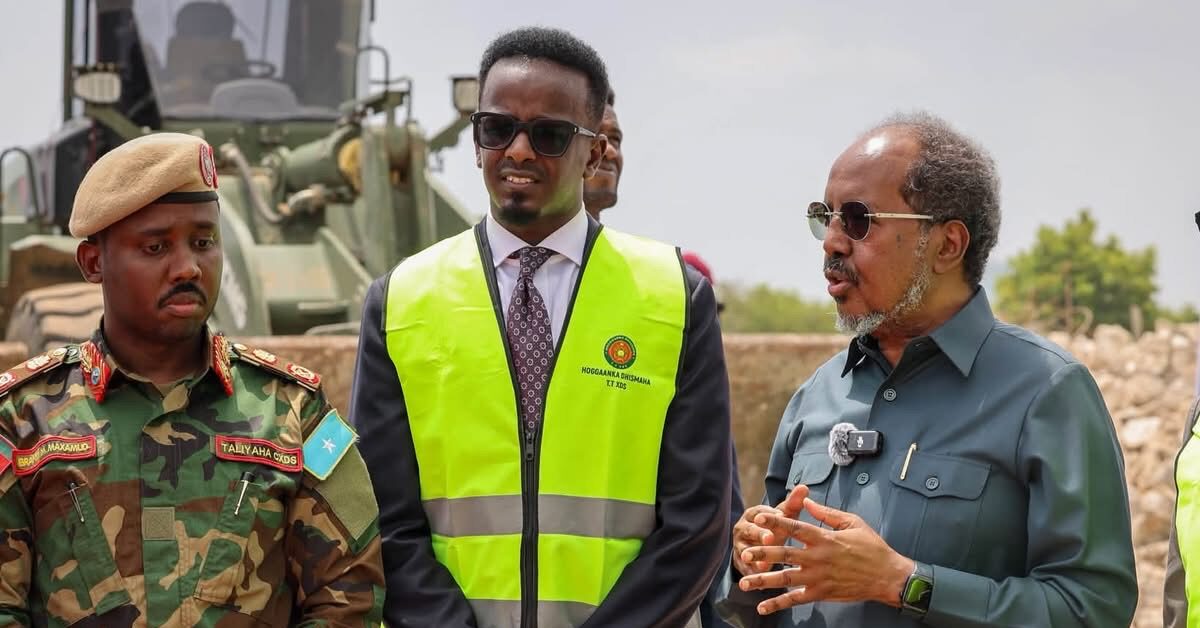
The remarks came during a foundation-laying ceremony for a new National Defence University and the reconstruction of Somalia’s Military Hospital, with China supporting these projects. Hassan Sheikh delivered the speech while appearing alongside Somalia’s defence minister and the Chinese ambassador to Somalia.
“A person who is angry and runs to a foreigner to seek their interest cannot bring great harm to the country,” the president said in remarks delivered in Somali.
He added that consultations were continuing and expressed hope that discussions would begin soon.
The presidency had scheduled the summit for 14-18 November to address Somalia’s electoral framework and ongoing constitutional reforms. However, members of the Somali Future Council, an opposition coalition that includes former president Sharif Sheikh Ahmed and several former prime ministers, declined to participate.
According to Somali media reports, the alliance, as well as the administrations of Puntland and Jubaland, rejected the format of the talks, arguing that negotiations should take place under broader guarantees rather than a process managed by the presidency.
Opposition groups have called for the involvement of the so-called Quartet, comprising the United States, the United Kingdom, the European Union, and Türkiye, to help facilitate discussions and provide assurances for any political settlement.
The dispute comes amid wider disagreements over electoral reforms, constitutional amendments, and the transition toward a one-person, one-vote electoral system.
Tensions have also been heightened by a recent Supreme Court ruling concerning the legal status of federal institutions and constitutional amendments adopted during the current electoral transition. While opposition groups have cited the ruling in support of their position, the federal government maintains that the electoral timetable established by national institutions remains in effect.
Political negotiations are expected to continue in the coming weeks as federal authorities, regional administrations, and opposition leaders seek agreement on a framework for Somalia’s next electoral process.