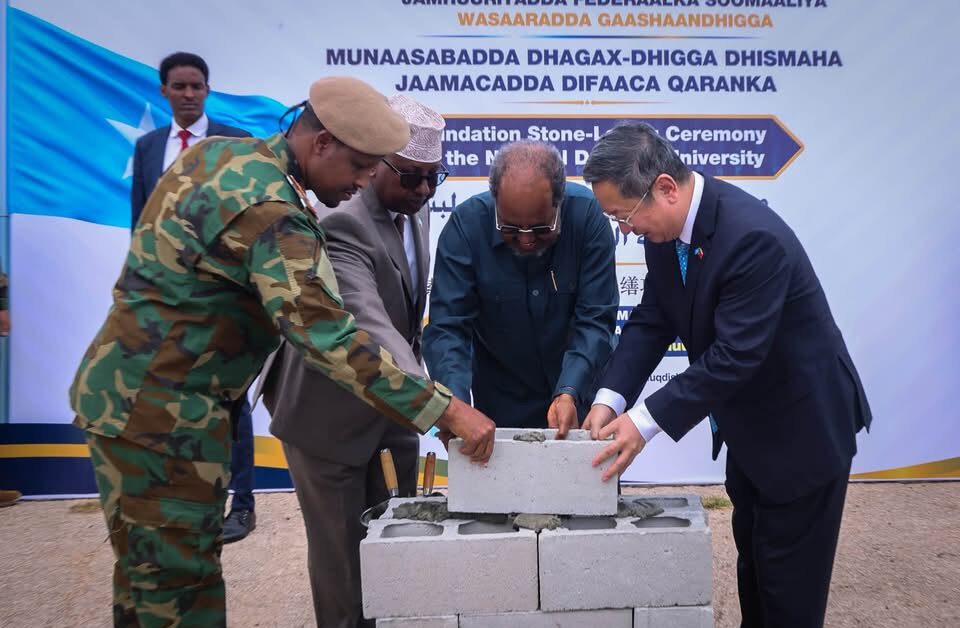
President Hassan Sheikh Mohamud laid the foundation stone on Sunday for Somalia’s new National Defence University (Jaamacadda Difaaca Qaranka) and the reconstruction of the Somali National Army (SNA) Military Hospital, marking a major institutional step in Mogadishu’s effort to build indigenous military education and healthcare capacity.
According to dispatches from the Somali National News Agency (SONNA) and Villa Somalia, the planned university campus will feature specialised academic faculties, research centres, tactical training grounds, and residential dormitories. State media confirmed that the Government of China is supporting the university’s establishment as part of President Mohamud’s broader drive to modernise military education and cultivate qualified Somali defence professionals capable of safeguarding national sovereignty.
While neither Villa Somalia nor the Chinese Embassy in Mogadishu immediately released technical details regarding the project’s financing mechanism, construction timeline, or executing contractor, the groundbreaking follows an intensified round of bilateral defence diplomacy in the second half of 2026. Just six days before the ceremony, on November 9, Chinese Ambassador Wang Yu held talks with Somali Defence Minister Ahmed Moallim Fiqi in Mogadishu. Those discussions built on Minister Fiqi’s September meetings in Beijing with Chinese Defence Minister Admiral Dong Jun, where both sides agreed to accelerate the implementation of existing defence understandings and Beijing’s ongoing officer training programmes for the Somali armed forces.
Alongside the university launch, President Mohamud initiated the reconstruction of a three-storey SNA Military Hospital and formally reactivated the Construction Command under the Somali National Army Support Command (Hoggaanka Dhismaha Taliska Taakuleynta Ciidanka Xoogga Dalka Soomaaliyeed). Unlike the Chinese-backed university project, the hospital rebuild is being executed directly by the reactivated SNA engineering unit, which the presidency tasked with accelerating internal military infrastructure, maintenance, and facility development nationwide.
Defence Minister Ahmed Moallim Fiqi described the move as a historic step in rebuilding the Somali military. He stated that the goal is to provide a complete educational path for officers from recruitment to the highest levels of command.
“A nation that wants to rely on its defence must first build the knowledge and institutions that produce its defence leaders,” Fiqi said. He expressed hope that the institution would eventually become a regional hub for defence studies in the Horn of Africa.
Why it matters
The establishment of a dedicated National Defence University marks a strategic shift for Somalia from basic tactical and counter-insurgency instruction toward advanced military doctrine, institutional research, and officer-level strategic education. The initiative comes at a critical juncture in Somalia’s security transition: following the handover from the African Union Transition Mission in Somalia (ATMIS) to the African Union Support and Stabilisation Mission in Somalia (AUSSOM) in January 2025 and the formal conclusion of the United Nations Transitional Assistance Mission in Somalia (UNTMIS) mandate on October 31, 2026, Mogadishu faces mounting pressure to consolidate national ownership and assume primary responsibility for its territorial security amid ongoing AUSSOM financing and drawdown uncertainties.
Historically, the Somali National Army (SNA) has relied on a patchwork of bilateral partners to generate and train its forces—most notably Türkiye through its Camp TURKSOM facility in Mogadishu and Gorgor commando pipelines, the United States via its Danab brigade mentorship, and the United Arab Emirates—creating distinct doctrinal and operational silos across elite units. Establishing a domestic academy backed by China—whom President Hassan Sheikh Mohamud described at Sunday’s ceremony as one of Somalia’s “closest allies”—signals both a deliberate diversification of Mogadishu’s external defence partnerships and an institutional effort to standardise command education under a unified national curriculum.