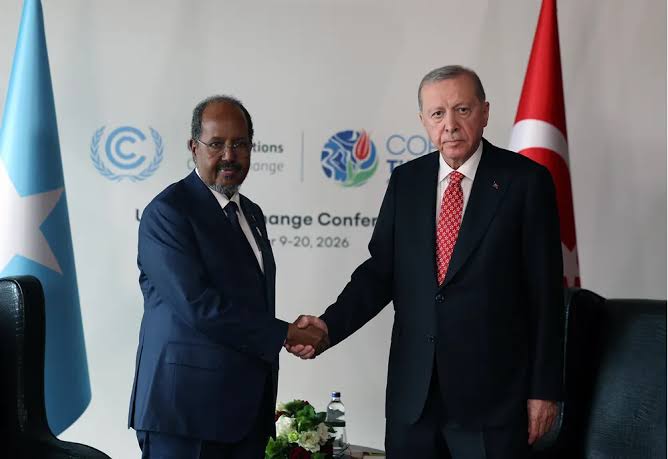
President Hassan Sheikh Mohamud met his Turkish counterpart, Recep Tayyip Erdoğan, in Antalya on Thursday to discuss widening cooperation on security, politics and economic development, the Mogadishu-based news site Caasimada Online reported.
Hassan Sheikh is in the southern Turkish city for COP31, the UN climate conference that opened on 9 November and runs until 20 November. The two leaders reviewed existing agreements on infrastructure and trade and said they wanted to broaden the partnership further. No new agreements were announced.
Why it matters
Türkiye is one of Somalia’s most important foreign partners, and its role now spans the military, the sea and the energy sector. Ankara has trained thousands of Somali soldiers since 2017 at Camp TURKSOM in Mogadishu, its largest military base abroad. In July 2026 the Turkish parliament extended the mandate for Turkish troops to stay in Somalia, at Mogadishu’s request.
The 2024 Defence and Economic Cooperation Framework Agreement goes further, committing Türkiye to help rebuild Somalia’s navy and protect its territorial waters for a decade. A separate oil and gas agreement signed in March 2024 led to seismic surveys of three offshore blocks, covering nearly 5,000 sq km, by the Turkish research vessel Oruç Reis. The drillship Çağrı Bey reached Somali waters in April 2026 and is drilling the Curad-1 exploration well. Somali officials expect the first results before the end of the year.
The energy terms remain contested at home. Under the 2024 production-sharing arrangement, Türkiye can take up to 90% of early revenue to recover its exploration costs, a clause that critics in Somalia say gives away too much before a single barrel has been found.
Trade is far less balanced than the politics. Türkiye exported goods worth $356 million to Somalia in 2024, mostly wheat products and iron, while Somalia sold Türkiye goods worth $21.2 million, according to the Observatory of Economic Complexity.
What to watch
The Curad-1 results are the next test of the partnership. A commercial find would raise the stakes over revenue-sharing between Mogadishu and the federal member states, which Somalia’s provisional constitution leaves to be negotiated. A dry well would shift attention back to security, where Turkish support for the war against al-Shabaab, the al-Qaeda-linked militant group, remains central to the relationship.